
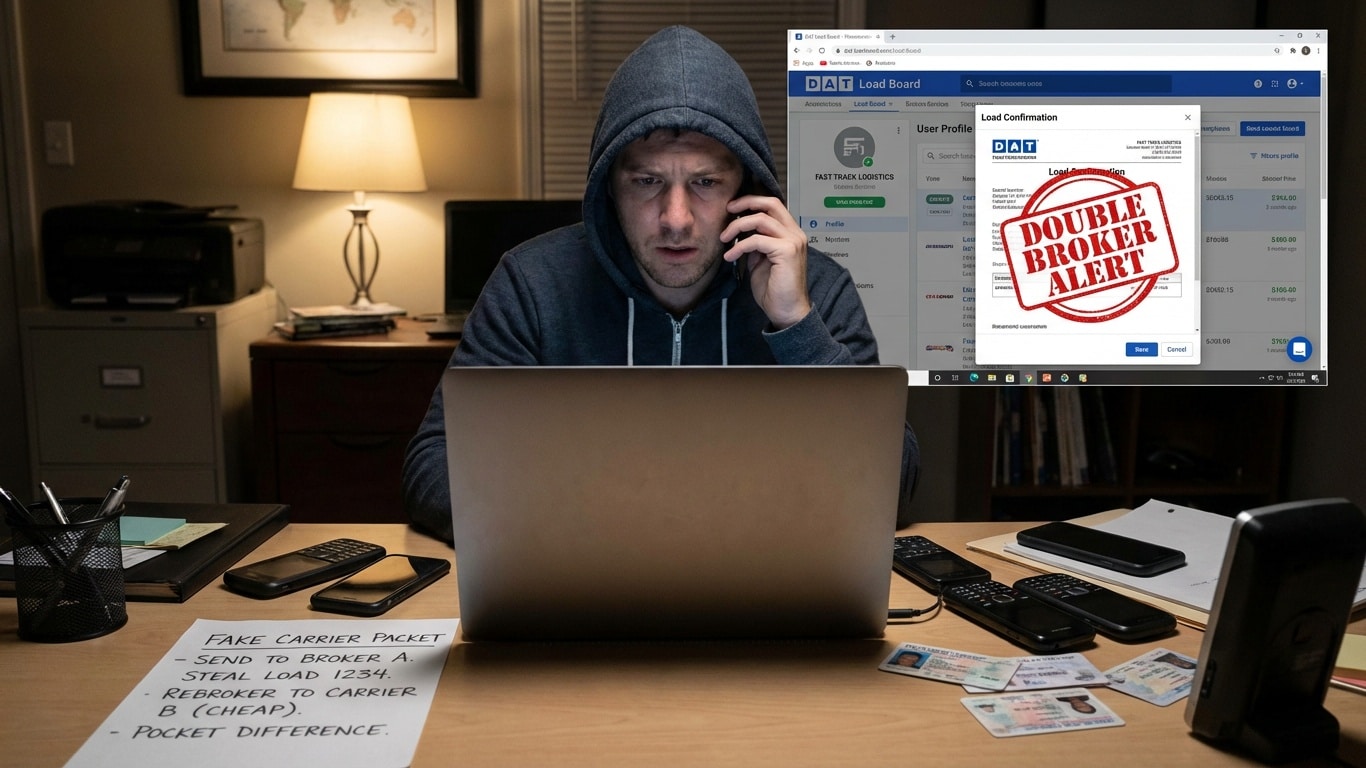
Cargo theft continues to surge across the United States—and food and beverage products are still the main targets.
Believe it or not, supply chain losses from cargo theft surged to nearly $725 million in 2025.
Recent Cargo Theft Headlines
Just last month, a sophisticated phishing campaign targeted freight and logistics companies across the U.S. and Europe. A financially motivated group dubbed “Diesel Vortex” was stealing credentials from freight and logistics operators in the U.S. and Europe in phishing attacks using 52 domains.
This digital threat is just the latest reminder that risks in this industry aren’t purely physical: the lines between cyber and cargo crime are only getting blurrier with advanced technology.
Types of Cargo Theft Attacks
Physical theft is the primary form of cargo crime, but thieves are also targeting their victims through cyber scams and identity theft. They do this by creating fictitious pickups in which they pretend to be a legitimate trucking company operating on load boards (online freight management systems). Sometimes they even call freight brokers and shippers directly to solicit the ability to move loads.
According to Verisk CargoNet, 3,594 supply chain crime events were recorded in the U.S. and Canada in 2025, with confirmed cargo theft incidents rising 18% year over year. The average theft value has also increased 36% to $273,990 year over year, driven by organized criminal groups targeting higher-value freight.
Double brokering, cargo theft, and identity fraud are becoming more sophisticated, which only adds risk (and cost) to moving high-value CPG goods. As a result, shippers are being pushed to tighten vetting processes and work with more trusted partners.
Zipline Logistics Carrier Qualification & Fraud Prevention Process
At Zipline Logistics, protecting our customers’ freight is a top priority.
That’s why we maintain a strict carrier qualification process designed to verify every carrier’s identity, safety record, operational history, and legitimacy before they ever haul a load. Our team conducts multiple verification checks during onboarding—and again before loads are booked—to ensure shipments are handled only by trusted partners.
Below is an overview of the steps our team follows.
Step 1: Carrier Identification
Our operators begin with a direct phone call to the carrier to confirm key identifying information.
This includes verification of:
- Carrier name and company name
- Primary phone numbers
- MC and DOT numbers
This step ensures we are communicating directly with the authorized carrier and not an impersonator.
Step 2: Carrier Safety & Compliance Assessment
Using industry verification tools—including SAFER Web, Carrier411, HighWay, and DAT CarrierWatch—our operators confirm the carrier’s operating status and review key safety metrics.
This assessment includes:
- Active operating authority
- Carrier operation class and operating authority type
- Safety rating and inspection data
- Crash history and safety performance
Carriers must pass a series of internal rule assessments to move forward. Any carriers with alerts related to identity theft, fraudulent activity, or malicious behavior are immediately disqualified.
Step 3: Carrier Qualification & Fraud Screening
Once initial compliance checks are completed, our team performs deeper verification to confirm the carrier’s legitimacy and operational reliability.
This includes reviewing:
- Equipment type and capacity
- Insurance coverage and authority status
- Certifications and regulatory records
- Verified contacts, dispatch services, and FMCSA information
Before onboarding, Zipline Logistics conducts an in-depth background check to ensure all carriers we work with meet the below criteria.
DOT and FMCSA Requirements:
- Minimum auto liability of $1,000,000
- Minimum cargo liability of $100,000
- Equipment that is no more than 10 years old
Zipline Logistics Carrier Expectations:
- No history of fraud
- Experience shipping into retail
- GPS tracking capabilities
- Consistent check-ins
- On-time performance
These steps help identify common fraud tactics, including situations where bad actors gain access to a legitimate carrier profile, update contact information, and impersonate that carrier.
Step 4: Carrier Onboarding
Once a carrier passes the qualification process, our team completes formal onboarding procedures.
This includes:
- Sending and reviewing the carrier onboarding packet
- Verifying insurance coverage and certificate details
- Confirming contact information on insurance certificates
- Reviewing carrier references to validate operational legitimacy
Special attention is given to potential risk indicators. For example, Gmail addresses are flagged and reviewed due to their historical association with double brokering and identity fraud cases.
Step 5: First Load Verification
Before a carrier moves their first shipment with Zipline, our team performs a final verification process.
Operators will:
- Review all shipment details with the carrier
- Confirm driver status and contact information
- Clearly communicate service expectations
- Check DAT load boards to ensure the shipment has not been reposted by another company (a common sign of double brokering)
Zipline’s carrier qualification process is designed to proactively prevent fraud, reduce risk, and ensure every shipment is handled by trusted transportation partners.
By combining direct verification, multiple industry databases, fraud screening tools, and ongoing monitoring, we maintain a carrier network that CPG brands can rely on to move freight safely and securely.
Additional Requirements for High-Value Shipments
High-value (HVL) freight requires an additional level of scrutiny.
Our industry-leading HVL process includes critical qualification, routing, and dispatch practices: from validating the lowest risk routing and driver mitigation best practices to visibility requirements and connectivity to law-enforcement. These updated technology integrations take an already world-class solution to the next level of anti-theft security.
To qualify for these shipments, carriers must:
- Be fully vetted and approved within the Zipline network
- Have no prior FreightGuard or Watchdog reports
- Have at least two years of history working with Zipline
- Operate a minimum of six trucks in the market
- Provide proof of insured VINs associated with the carrier
When required, we make direct contact with our network of law enforcement and security partners through Overhaul LE Connect technology. Your freight is protected by around-the-clock expert monitoring and multi-region security operations centers.
Track and Trace with Advanced Technology
Zipline’s proprietary shipper intelligence tool, KANOPI, provides clients with high-powered visibility and data to track and trace shipments every step of the way. KANOPI’s illustrative maps display real-time updates pulled from GPS tracking and manual check-ins with carriers so you always know where your freight is and have peace of mind.
In addition to providing high visibility that protects your shipments against theft, KANOPI optimizes supply chain efficiency, reduces costs, and skyrockets logistics performance.
KANOPI has helped Zipline clients achieve up to:
- $1.2 Million in transportation savings
- 20% reduction in cost per pallet through consolidation
- 17% improvement in meeting on-time in-full delivery (OTIF)
- 30% increase in network efficiency
- 861,908 fewer projected miles traveled overall
Cargo Theft Insurance Coverage
Zipline Logistics maintains cargo theft insurance coverage on every load we move. For more information, contact Zipline using the button below.
Trust Zipline With Your Shipments
Specialized in high-visibility retail deliveries, we are so much more than a rate and a truck. At Zipline, we leverage our retailer logistics expertise, best-in-class processes, and uniquely qualified carrier network to ensure our customers are protected from theft and on-shelf at top locations on-time and in-full.
